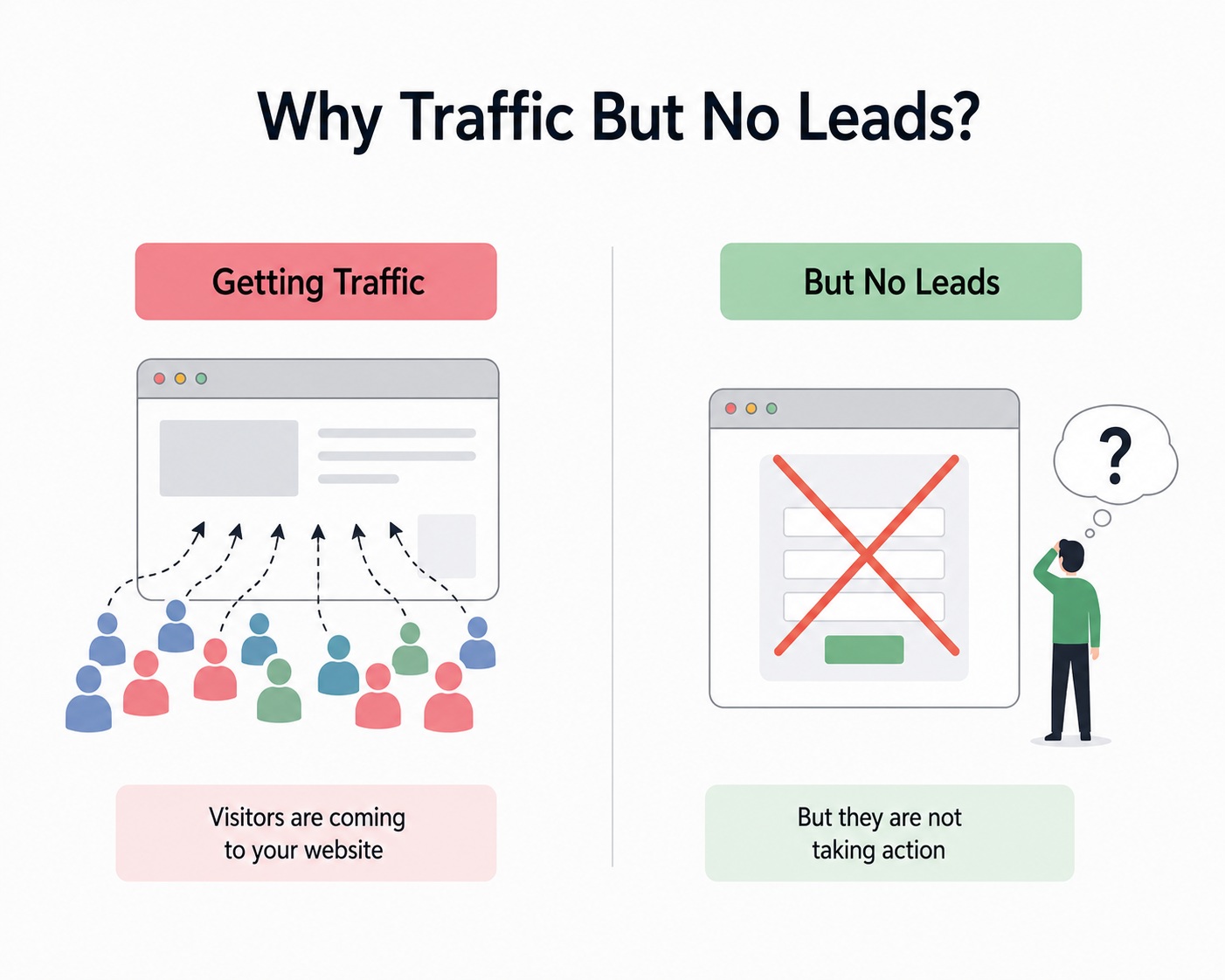
Website Getting Traffic but No Leads
Many business owners celebrate
when website traffic starts increasing. More visitors usually mean your SEO,
social media, advertising, or content marketing efforts are working. However,
what happens when hundreds or even thousands of people visit your website every
month, but hardly anyone fills out a form, calls your business, or requests a
consultation?
This is one of the most common
challenges businesses face in digital marketing. Traffic alone does not
generate revenue. Leads and conversions do. If your website is attracting
visitors but not producing inquiries, there are likely several issues preventing
potential customers from taking action.
1. Your Website Is Attracting the Wrong Audience
One of the biggest reasons for
low lead generation is poor audience targeting.
Your website may rank for
keywords that bring visitors who are not actually interested in your products
or services. For example, a company offering enterprise IT services may attract
users searching for free software downloads or general technology information.
Review your traffic sources and
keywords using tools like Google Analytics and Google Search Console. Focus on
attracting visitors who have buying intent rather than those who are simply
looking for information.
2. Your Value Proposition Is Not Clear
When visitors land on your
website, they should immediately understand:
* What you offer
* Who you help
* Why they should choose you
* What action they should take
next
If your homepage is filled with
technical jargon, vague messaging, or too much information, visitors may leave
without understanding your business.
A strong value proposition should
be visible within seconds of landing on your website. Clear headlines, concise
descriptions, and customer-focused messaging can significantly improve
conversions.
3. Weak or Missing
Call-to-Action (CTA)
Many websites assume visitors
will automatically know what to do next. Unfortunately, that rarely happens
Every important page should
include clear calls-to-action such as:
* Book a Free Consultation
* Request a Demo
* Get a Free Quote
* Download the Guide
* Contact Our Team
Your CTA should stand out
visually and clearly explain the benefit of taking action.
4. Poor User Experience (UX)
Visitors quickly leave websites
that are difficult to use.
Common UX problems include:
* Slow loading pages
* Confusing navigation
* Broken links
* Poor mobile responsiveness
* Difficult contact forms
Research shows that users expect
websites to load within a few seconds. Even a small delay can increase bounce
rates and reduce conversions.
Regularly test your website on
desktop, tablet, and mobile devices to ensure a smooth experience for every
visitor.
5. Lack of Trust Signals
Visitors are unlikely to submit
their information if they do not trust your business.
Trust-building elements include:
* Customer testimonials
* Client success stories
* Case studies
* Industry certifications
* Awards and recognitions
* Verified reviews
* Security badges
Showing social proof helps
potential customers feel confident that your business can deliver results.
6. Your Lead Form Is Too Complicated
Long forms can discourage
visitors from converting.
Many businesses ask for excessive
information during the first interaction. Instead of requesting ten fields,
consider asking only for:
* Name
* Email
* Phone Number
* Brief Requirement
The easier it is to contact you,
the higher your conversion rate will typically be.
7. No Follow-Up Strategy
Not every visitor converts during
their first visit.
In fact, many prospects need
multiple interactions before making a decision. Businesses that fail to follow
up often lose valuable opportunities.
Effective follow-up methods
include:
* Email nurturing campaigns
* Retargeting advertisements
* WhatsApp engagement
* Personalized content
recommendations
* Marketing automation
AI-powered retargeting solutions
can help re-engage visitors who leave your website without converting.
8. Your Content Doesn't Match User Intent
A visitor searching for
"best cloud migration services" expects different information than
someone searching for "what is cloud computing."
If your content does not align with
the visitor's stage in the buying journey, conversions may suffer.
Create content for every stage:
* Awareness Stage
* Consideration Stage
* Decision Stage
Guide visitors from learning
about a problem to choosing your solution.
9. You're Not Measuring
Conversion Data
Many businesses focus only on
page views and traffic numbers.
Instead, monitor metrics such as:
* Conversion Rate
* Bounce Rate
* Form Submissions
* Call Tracking
* Landing Page Performance
* User Behavior Flow
Understanding where visitors drop
off allows you to identify and fix conversion bottlenecks.
10. Your Website Is Not Optimized for Lead Generation
A website should function as a
sales and marketing tool—not simply an online brochure.
High-converting websites
typically include:
* Clear messaging
* Strong CTAs
* Lead magnets
* Trust signals
* Fast loading speed
* Mobile optimization
* Retargeting systems
* Conversion tracking
Businesses that continuously test
and improve these elements consistently generate more leads from the same
amount of traffic.
Final Thoughts
Getting website traffic is only
the first step toward online success. If visitors are not converting into
leads, your business may be losing valuable opportunities every day.
The solution is not always
increasing traffic—it is often improving conversion optimization. By targeting
the right audience, strengthening your messaging, building trust, simplifying
lead capture, and implementing retargeting strategies, you can turn more
website visitors into qualified leads and paying customers.
Remember: A website that receives
500 targeted visitors and converts 10% of them is far more valuable than a
website receiving 5,000 visitors with almost no conversions.